Archive for the ‘Choosing And Selecting Nikon Lenses’ Category

Why Use Prime Lenses

Grasshopper on Hibiscus

A prime lens is a fixed focal length lens, why do photographers use these prime lenses and what are their advantages over zoom lenses?

There are quite a few reasons why photographers use prime lenses and I will summarise some of the reasons below.

Size and Weight

Prime lenses are generally quite a bit smaller and lighter than the equivalent focal length lenses in the zoom range. Many of the f/2.8 zoom lenses are much larger than the equivalent prime lens with the same focal length.

Aperture

One of the most important considerations for many photographers is the minimum aperture of the lens.  The aperture of the lens determines the low light capability of the lens.

The minimum aperture also determines the effectiveness of the lens in providing satisfactory selective focus. Many images are improved by using selective focus to help create more impact with images. A low aperture will provide a very narrow depth of field and some of the lenses in the Nikon range which are great for this are as follows;

  • 24mm f/1.4,
  • 35mm f/1.4,
  • 50mm f/1.4,
  • 50mm f/1.8,
  • 85mm f/1.4,
  • 85mm f/1.8,
  • 105mm f/2.0,
  • 105mm f/2.8 Micro,
  • 135mm f/2.0,
  • 180mm f/2.8,
  • 200mm f/2.0,
  • 400mm f/2.8.

All of the lenses above ranging  from wide angle to super telephoto, will provide an excellent narrow depth of field.

Bokeh

The bokeh is the out of focus characteristic of the lens. Many of the prime lenses listed above offer excellent Bokeh characteristics to further improve their excellent image quality.

Image Quality

Prime lenses are designed for the specific focal length and hence are generallY of better quality than the zoom lens of the same focal length. Many characteristics of a lens determine the quality and somme are summarised as follows;

  • Resolution,
  • Centre sharpness,
  • Edge and corner sharpness,
  • Colour aberations,
  • Vignetting.

Special Applications

Prime lenses are designed for special applications, such as close up applications, there are quite a few Nikon Micro prime lenses which offer exceptional performance for macro photography. There are also many prime telephoto lenses designed for special use such as the f/2.8 telephoto lenses for sporting applications. There are also several f/4 super telephoto lenses aimed at nature, animal and bird photography.

Convenience

All the points above do give an advantage to the prime lenses. However there are disadvantages and that is convenience. For many applications the zoom lens is far more convenient due to the fact that in many cases you can keep shooting without the inconvenience of changing lenses.

There is a detailed review of all the current complete range of Nikon lenses in our Nikon lens Review Section.

Selecting Nikon Cameras and Lenses for Low Light Photography

Fireworks 5, Albert Park, Melbourne

When you are selecting a particular camera and lens for low light photography there are a few special issues to keep in mind and we will summarise some of the important considerations here.

In using high ISO settings bear in mind that if you use a tripod or monopod you can possibly use lower ISO settings and consequently get better image quality. High ISO is not necessarily always the best solution.

The Camera

With the camera the main issue to be aware of is the ISO capability of the camera.

DX Cameras

  • D3000 – ISO1600,
  • D3100 – ISO3200,
  • D5100 – ISO6400,
  • D7000 – ISO6400,
  • D300s – ISO3200.

FX Cameras

  • D700 – ISO6400,
  • D3s – ISO6400
  • D3X -ISO1600.

Many of the cameras indicated above do have ISO settings above those indicated, but the figures indicated above are the cameras maximum specified ISO, if an ISO setting above those indicated is selected, the image quality in respect to noise may not meet your needs. The above figures give a general comparison between cameras.

In general the best cameras for low light working in my opinion are the Nikon D700 and the D3s, these are both FX cameras with the larger sensor. The best DX camera for high ISO is the Nikon D7000.

Full details of the range of Nikon cameras are given in our Nikon Camera Review Section.

The Lenses

With lenses there are several factors affecting the low light capability of the lenses. Firstly the prime factor with lenses is the maximum aperture  and also a secondary consideration is whether the lens has the vibration reduction  (VR) functionality.

The maximum aperture with lenses can vary generally between f.1.4 and f/5.6. Here, there is an aperture variation of  four f stops and this variation can be a major issue when photographing in low light levels. Some lenses  have variable apertures and the aperture may vary from f/3.5 to f/5.6 as the lens zooms in and out from minimum to maximum focal length.

Many prime lenses have apertures varying from f/1.4 to f/2.8, an example of some of these lenses is as follows:

Nikon DX Lenses

  • 10.5mm f/2.8G ED AF DX Fisheye
  • 17-55mm f/2.8G IF ED AF-S DX
  • 35mm f/1.8G AF-S DX

Nikon FX Lenses (Full frame)

  • 16mm f/2.8D AF Fisheye
  • 14-24mm f/2.8G ED AF-S
  • 20mm f/2.8D AF
  • 24mm f/1.4G ED AF-S
  • 24-70mm f/2.8G ED AF-S
  • 35mm 1.4G AF-S
  • 50mm f/1.8G AF-S
  • 50mm f/1.4G AF-S
  • 60mm f/2.8G ED AF-S Micro
  • 70-200mm f/2.8G ED VR II
  • 85mm f/1.4G AF-S
  • 85mm f/1.8D AF
  • 105mm f/2.8G IF ED VR AF-S Micro
  • 200mm 2.0G ED AF-S VR II
  • 300mm f/2.8G ED VR II AF-S
  • 400mm f/2.8G ED VR

All of the above lenses are excellent lenses for low light photography, just select the lens based on the focal length you require.

Some of the best lenses for low light photography are the f/1.4 primes.

In using any of the above lenses with the VR functionality you will find that the VR facility will also be a great advantage when photographing stationary subjects. However VR is of no advantage when photographing moving subjects.

Full details of the range of Nikon lenses are given in our Nikon Lens Review Section.

Nikon Lens Review of Modulation Transfer Function (MTF) Charts
MTF Chart

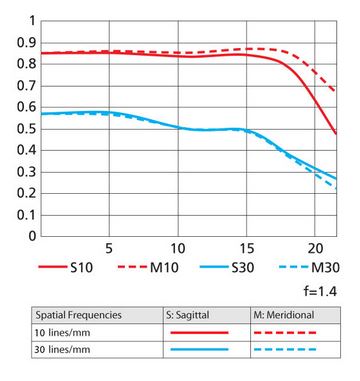
What are Modulation Transfer Function (MTF) charts for lenses. Well they are charts which indicate the general performance of the lens. There are technical performance measurements of lenses as well as the practical  performance from normal image making.

The above graph is the MTF chart for the Nikon 85mm f/1.4G AF-S Nikkor lens as an example. Many MTF charts for the Nikon lenses are shown on the Nikon web site.

How do you read and understand the MTF charts?

The Modulation Transfer Function for a lens, is a measurement which evaluates the lens general performance. It will show how the lens reproduces the contrast of the scene being photographed using characteristic spatial frequencies. The spatial frequencies effectively indicates the number of lines per mm of the image.

In the MTF chart above, the horizontal axis of the chart is in millimeters and shows the distance from the center of the image on the left hand side and towards the edges of the lens on the right hand side, the highest contrast value is at 1 on the vertical axis and reduces as you move down the verticle axis. The fixed spatial frequencies of 10 lines/mm and 30 lines/mm are shown on the graph.

The MTF chart for each seperate lens is based on the value at the maximum aperture setting and in the case 85mm lens above, this is f/1.4. The red line shows the spatial frequency of 10 lines/mm and the blue line, 30 lines/mm.

The path of the 10 lines/mm (red line) indicates the contrast of the lens, the higher and straighter the line the better the lens. The higher and straighter the 30 lines/mm (blue line), the higher the resolution of the lens.

MTF (Modulation Transfer Function) is only one of the measurements which evaluate the quality of the lens and it represents contrast using characteristic spatial frequencies.

Contrast reproducibility of the lens for sagittal or radial direction of the lens (solid line in the graph)  and meridional or tangential direction of the lens (dotted line in the graph) varies with astigmatic performance. The path of 10 lines/mm indicates the contrast reproducibility of the lens, the higher and straighter is better. The higher and straighter the 30 lines/mm-path is, the higher the resolution of the lens.

The performance of a lens is not only to be measured with the MTF charts, as some softening or blurring of color also affects the images.

For full details of Nikon Lenses see our Nikon Lens Reviews.

Nikon Lens Reviews For Landscape Images

Trees at Eagleby Wetlands

When capturing landscape images there is not really one category of lens required to form the image. It really depends on where you want to place the emphasis in the images. As an example in the image above, a 300mm lens has been used with the main aim to capture the silhouette of the trees against the greying sky in the background.

In general there are many options with lenses in capturing landscape images. I favour wide angles for wide expansive landscapes, however when using wide angle lenses, I like to include some part of the landscape as an object in the foreground of the image.

When using Nikon DX cameras, wide angle lenses in the range 10 to 24mm can be very effective with landscapes, but to get a similar effect with Nikon FX cameras, lenses in the range 14 to 35mm will be required.

When using wide angle lenses of 10 to 35mm a great depth of field can be obtained which helps to keep the whole scene in focus.

Generally when  taking landscape images, low aperture lenses are not required as it is better to aim for a wide depth of field to ensure that both the foreground and distance is in focus. I would often use an aperture of around f/8 to f/11 to ensure a satisfactory depth of field in the image when using a wide angle lens.

Rules are meant to be broken and for the image above, I used a long telephoto lens to select just a small part of the landscape, effective images can be obtained by selecting small parts of landscapes. For the above image an aperture of  f/13 and a shutter speed of 1/125 second was used at an ISO of 1600.

Very often with mountain scenery a long telephoto lens can be very effectively used, to select a very small part of a scene similar the the way I have with the above image. Bear in mind that using a telephoto lens for landscapes will provide a much narrower depth of field than a wide angle lens, so be very careful in framing the image where there are foreground objects in the image.

When selecting a telephoto lens for landscape images, I would choose a lens in the range 100 to 300mm.

We have extensive reviews of the range of Nikon lenses available and it may be useful to refer to our Nikon Lens Review section to help you choose a suitable lens for your landscape images.

In choosing a lens also think of other applications in which you may also use the lens, for example many landscape photographers also have an interest in nature and animal  and bird photography within the landscape.

One very important aspect of landscape photography often neglected is to use a tripod or monopod where possible to help obtain the sharpest image quality.

Nikon Portrait Lens Review

There are several types of portrait or people photography which may range from close up head shots to full body shots and groups of people, this will require a range of lenses from longish telephoto lenses, ranging through to wide angle lenses. So what is the best nikon lens for portrait photography?

We will discuss this under the main headings below. Bear in mind that there is a difference between DX cameras and FX cameras in respect to the focal length of lens required, due to the lens crop factor. I will quote focal length ranges and generally DX cameras would require the lower end of the range and FX cameras the higher end of the range.

Groups of People

A lens suitable for groups of people would generally be in the range from 24-50mm. Generally groups of people will require an aperture in the range f/5.6 to f/8, to ensure that there is sufficient depth of field to get everyone in focus. With groups of people it is essential that everyone is in focus.

Full Body Shots

For full single body images, a lens of around 35-50mm may work well. A suitable aperture would be  f/4 to  f/5.6 to ensure that all of the subject is in focus.

Upper Body and Head Shots

Generally for upper body and head images a lens of between 50 to 105mm would be useful and apertures of f/2.8 to f/4 would ensure that all is in focus.

Close Up Head Shots

Close up images generally require a lens between 85-135mm and apertures of between f/1.4 and f/4. Remember that low apertures of around f/1.4 will give a very narrow depth of field, so be very careful with the focussing.

Partial Head Shots

With a longer lens of between 150 to 200mm partial head shots can be obtained, but again remember that depth of field will be very limited at low apertures of f/1.4.

Summary

Some additional tips with people photography, is to use a tripod and also a remote release where possible, this will ensure accurate framing of the image and and ensure that there is no movement of the camera. Also remember that a low aperture will throw the background out of focus and help to concentrate the interest on the main subject of the image.
Full details of the range of focal length of lenses available is given in the Nikon Lens Reviews section of our site.
I hope the above discussion has clarified the best nikkor lenses for portrait photography, as it is not only about the best lens size for portraits, but a big impact on your images is also the  best aperture to be used.
B&H is my photography supplier and the largest photo reseller in the world.

Nikon Normal Lens Reviews

SS Dicky, Dicky Beach

Here I will review some of the normal focal length Nikon Lenses. You may ask what is normal in photography, well by normal I am meaning a lens which gives a viewing angle similar to what we see with the human eye. The viewing angle of the human eye is around 45 degrees.

There are essentially two types on Nikon cameras, FX which uses a full frame 24x36mm sensor size and DX cameras, which use a sensor which is essentially a cropped format, and this has a 16 x 24mm sensor size. Each of these cameras will provide a different angle of view when the same lens is used.

DX Cameras

With a DX camera using the smaller sensor size, a normal lens would be regarded as a 35mm lens. The Nikon 35mm f/1.8G AF-S DX Lens is a lens which offers a viewing angle of 44 degrees which is roughly the same as the angle of the human eye. This lens is quite cheap to purchase and has very good image quality.

The Nikon 35mm 1.4G AF-S Lens will offer a similar image quality to the f/1.8 version but is more useful in low light as it has a minimum aperture of  f/1.4. Again this lens has a viewing angle of 44 degrees. The 35mm f/1.4 lens is essentially an FX lens but it is also a lens which can be used with DX cameras and will perform with excellent image quality. This lens is significantly more expensive than the f/1.8 version.

FX Cameras

When using an FX full frame camera a normal lens is generally regarded as 50mm. The Nikon 50mm f/1.8G AF-S Lens will give a viewing angle of 47 degrees with an FX camera and is a lens with excellent image quality, The above image has been captured with an 50mm f/1.8 lens. This image was captured after dark when the f/1.8 aperture is very useful.

The Nikon 50mm f/1.4G AF-S Lens will provide a viewing angle of 46 degrees but offers an improved low aperture of f/1.4 hence id more useful in low light applications.

Lens Reviews

There are more detailed reviews and information on the above normal lenses in our Nikon Lens Review section.

In photography some photographers shy away from the normal focal length lenses, but from my experience these lenses can provide a very nice perspective to our photographic images. There is also one overlooked aspect of these normal lenses and that is that they are generally quite cheap, especially the f/1.8 versions. The f/1.8 normal lenses are also very compact, light weight and easy to fit into our camera bags.

Nikon VR Lenses

Bee on Daisy

What is VR in Nikon lenses and what is all the hype about it. Well VR stands for Vibration Reduction and it reduces the effect of any camera and lens vibration.

How does it Work?

The Nikon VR System works by adjusting elements within the lens to compensate for camera shake of the lens and camera. Motors are used to control the elements to reduce the camera shake. The angular movement of the lens is detected, both vertical movement and horizontal, together with the velocity of movement and the amount of compensation is calculated via a micro computer within the lens, to move the VR unit of the lens to compensate for the lens movement.
The built in microcomputer inside the lens, calculates the amount of lens element movement necessary, using the data from the angular velocity sensors.
The VR operation of the lens is activated by lightly pressing the shutter release button. When the camera shutter release button is lightly pressed, the VR elements in the lens give  a smooth viewfinder image. During the exposure however, the algorithm changes to compensate for every slight movement of the lens.
With most interchangeable VR lenses, VR operation is activated by lightly pressing on the shutter release button. When a photographer is recomposing a picture while keeping the shutter release button half pressed, the system can instantly tell whether camera movement is intentional or caused by camera shake and act accordingly. For example VR does not compensate for recomposing movement that camera movement, because if it did, the photographer could have difficulty accomplishing the desired composition.

Generally the image blur caused by camera shake occurs when shutter speeds are slower than 1/focal length of the lens. With the implementation Nikon’s latest VRII system, the lenses give an ability to shoot at four times lower shutter speed than you could obtain without the VR functionality.

When should the VR functionality be Switched on

In general I only use VR at slow shutter speeds. For example with the 105mm VR Micro lens I would only use VR at shutter speeds of less than 1/100 of one second. At these low shutter speeds I see significant advantages with the VR operation. I have actually used the 105mm Micro lens at shutter speeds of 1/6 second an have obtained sharp images. It should be noted that VR does not work well with macro work once the reproduction ration is les than 1:10 so turn it off for macros.

VR is also now provided with some of the wide angle zoom lenses. With the 24-120mm zoom I have obtained sharp images at 24mm with a shutter speed of 1/4 second, which is quite remarkable.

Where the VR functionality really shines is with the super telephoto lenses, where hand held sharp images can be obtained in some case with shutter speeds down to 1/50 second.

Which Lenses Have VR

In the Nikon Lens Reviews we have listed all the Nikon lenses which have VR built in.

Travelling Photography – Nikon Lens Reviews for Travellers
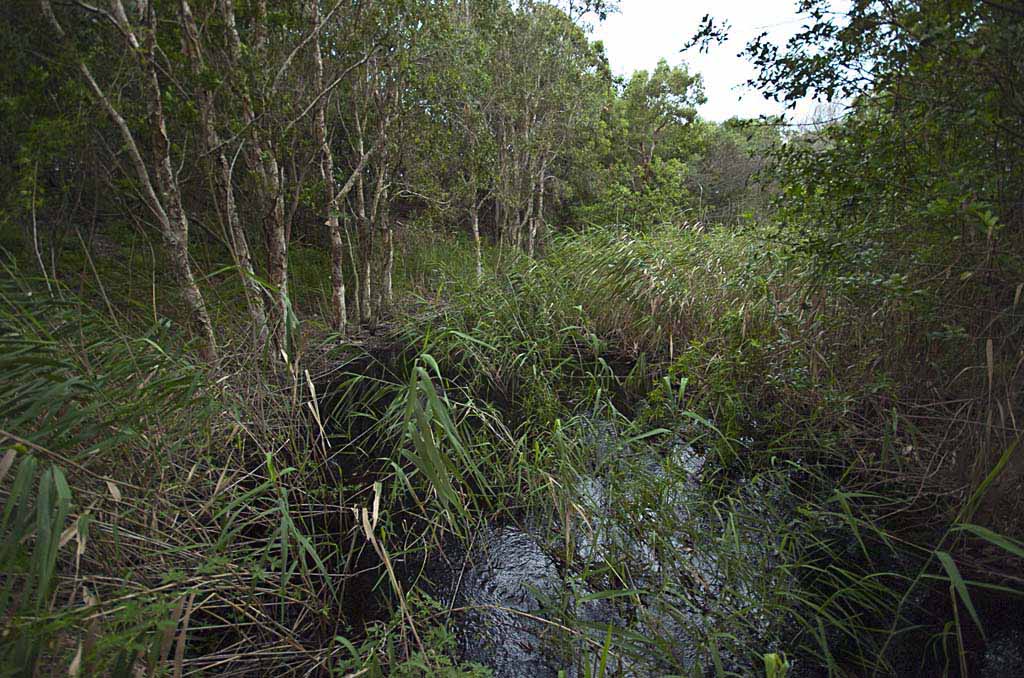
When travelling, the secret for an enjoyable trip is to travel light but also to have enough equipment to satisfy your photographic needs to achieve high image quality. Your needs may vary from wide angle lenses for  landscapes to super telephoto lenses for distant birds and animals.

For travelling the Nikon range of DX cameras and lenses are excellent as they are quite a bit smaller that the equivalent FX lenses. There are full details of the renge of Nikon lenses in the Nikon Lens Reviews section.

DX Prime Lenses for Travelling

If you are keen in prime lenses for travelling then a selection as follows may be appropriate:

  • Nikon 20mm f/2.8D AF,
  • Nikon 50mm f/1.8G AF-S,
  • Nikon 85mm f/1.8D AF.

These three lenses will cover the range most photographers would require when travelling, however if a longer lens is required then you could add the Nikon 300mm f/4D IF ED AF-S which is an extremely sharp lens.

DX Zoom Lenses for Travelling

For the zoom lens traveller some of the suitable zoom lens selections are as follows:

  • Nikon16-85mm f/3.5-5.6G ED VR AF-S DX,
  • Nikon 70-300mm f/4.5-5.6G IF ED VR AF-S.

The above zoom selection will provide an excellent range, however is a wider angle lens is required then the Nikon 10-24mm f/3.5-4.5G ED AF-S DX lens could be added.

FX Prime Lenses for Travelling

For photographers using FX cameras and prime lenses you should probably be aiming for the higher performance lenses to get the best image quality. An excellent selection is as follows:

  • Nikon 24mm f/1.4G ED AF-S,
  • Nikon 50mm f/1.4G AF-S,
  • Nikon 85mm f/1.4G AF-S  OR  Nikon 105mm f/2.8G IF ED VR AF-S Micro.

Again if a high quality long lens is required then you could not beat the Nikon 300mm f/2.8G ED VR II AF-S, this lens is one of the sharpest Nikkors available.

FX Zoom Lenses for Travelling

Some of the FX zoom lenses are quite large and they consequently can add a lot of weight to your camera bag. Some of the best zooms are as follows:

  • Nikon 14-24mm f/2.8G ED AF-S,
  • Nikon 24-70mm f/2.8G ED AF-S  OR  Nikon 24-120mm f/4.0G ED VR,
  • Nikon 70-200mm f/2.8G ED VR II  OR  Nikon 70-300mm f/4.5-5.6G IF ED VR AF-S  OR  Nikon 200-400mm f/4G ED ASF-S VR II

There are quite a few optiions for the above lenses and the final selection will depend on wheter you have a preference for the wide end or for the telephoto end of the range.

Nikon Fisheye Lens Reviews

Where you have a wide landscape it is sometimes nice to have a fisheye lens to capture the scene. However the lens you use will depend on weather you use a DX or FX full frame camera.

Nikon DX (APS-C) Lenses

With the Nikon 10.5mm f/2.8G Fisheye Lens Review we have the widest lens for the DX cameras. This lens covers 180 degrees and gives a full fisheye effect. In general the fisheye lens will create distortion of the scene but some photographers like this effect, there is plenty of software available which can correct the distortion in photoshop. This lens is considered as an excellent lens with very high image quality with some photographers consider even shaving off the built in lens shade and using the lens on full frame FX cameras, it can prove to be quite effective when used in this way. This fisheye lens has excellent image quality and is highly recommended.

There have been many many beautiful images taken with this fisheye lens. As an example of some beautiful images with this lens take a look at the Flickr  site for images of the Nikon 10.5mm fisheye lens.

Nikon FX Lenses (Full frame)

The fisheye lens for full frame FX cameras is the Nikon 16mm f/2.8 Fisheye Lens. This lens is a much older design than the newer DX fisheye lens but it still provides a very useful wide, 180 degree view. Some of the subjects for a lens such as this would be landscapes and building interiors, if care is taken with the distortion or that the distortion is removed with software. Some spectacular sporting images have been taken with these fisheye lenses of subjects such as skate boarders and snow boarders and skiers.

If you are using a full frame Nikon FX camera then take a look at some of the images here of the Nikon 16mm Fisheye lens. This lens is  highly recommended if you want a super wide angle view and excellent image quality.

Nikon DSLR Lens Reviews

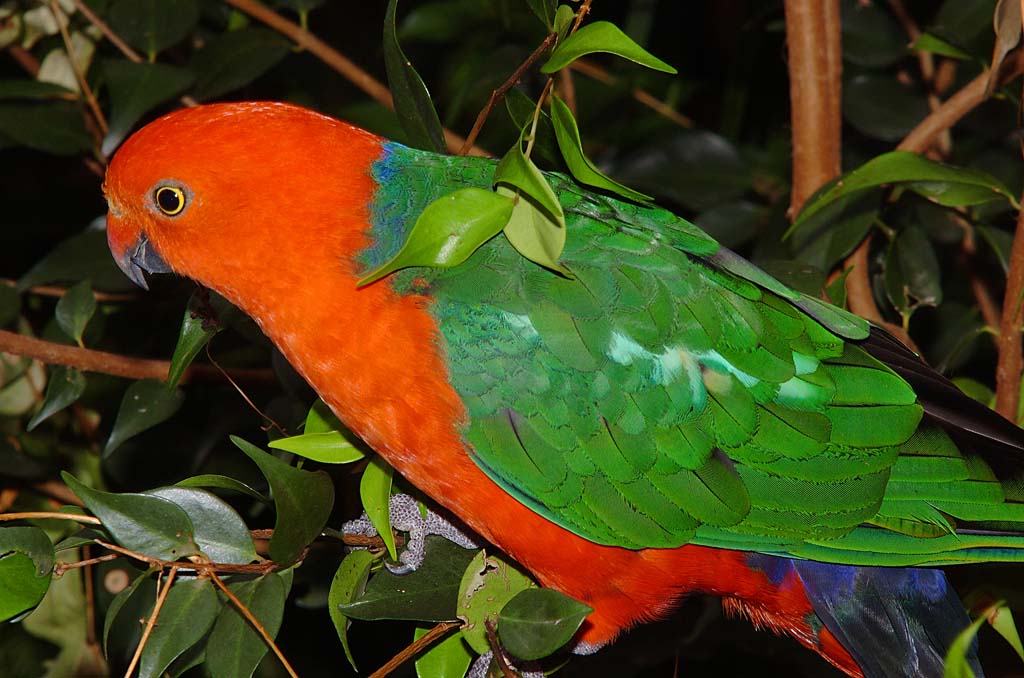
King Parrot

If you are selecting a lens for your Digital Single Lens Reflex (DSLR) camera, the selection of a lens will depend on many factors and we will attempt to summarise here some of the issues.

We have many lens reviews and summaries on this site, for most of the current Nikon lenses available, see them here at Nikon Lens Reviews and recommendations, where the full range of DX and FX lenses are categorised. The choices of lens are difficult and some of the following information and comments may assist in your selection.

Nikon DX Cameras and Lenses

The Nikon DX cameras use a smaller sensor than the full frame cameras, the DX sensor is essentially a cropped format, and has a 16 x 24mm sensor size, compared to the FX sensor size of 24×36mm.

The DX lenses only cover the area of the smaller sensor and if a DX lens is used on an FX camera the corners of the image will vignette and consequently be darker.

  • DX cameras can use DX lenses and full frame FX lenses. The current range of DX cameras is D300s, D7000, D5100, D3100 and D3000.
  • FX full frame cameras can only use the full frame FX lenses. The current range of FX cameras is D3X, D3s and D700.

AF-S Lenses

In the Nikon lens range, the AF-S lenses have a built in  motor within the lens for automatic focussing of the lens. Non AF-S lenses do not have built in focussing motors and rely on the camera internal motor for focussing. All the new release lenses  from Nikon in recent times do have AF-S motors but older lenses do not have the focussing motors. If a non AF-S lens is used on a camera with no focussing motor, then the lens will have to be manually focussed which may be unacceptable to many photographers.

All the current FX cameras  D3X, D3s and D700 do have the in camera AF-S focussing motors and consequently can accept AF-S and non AF-S lenses and provide auto focussing functionality.

The following current DX cameras have in camera AF-S focussing motors, D300s and D7000 and can accept AF-S and non AF-S lenses with full auto focussing. Other cameras may require the lens to be focussed manually.